Minister Jo Brouns visited a soil remediation site operated by Verhoeve Belgium

Published May 30, 2026

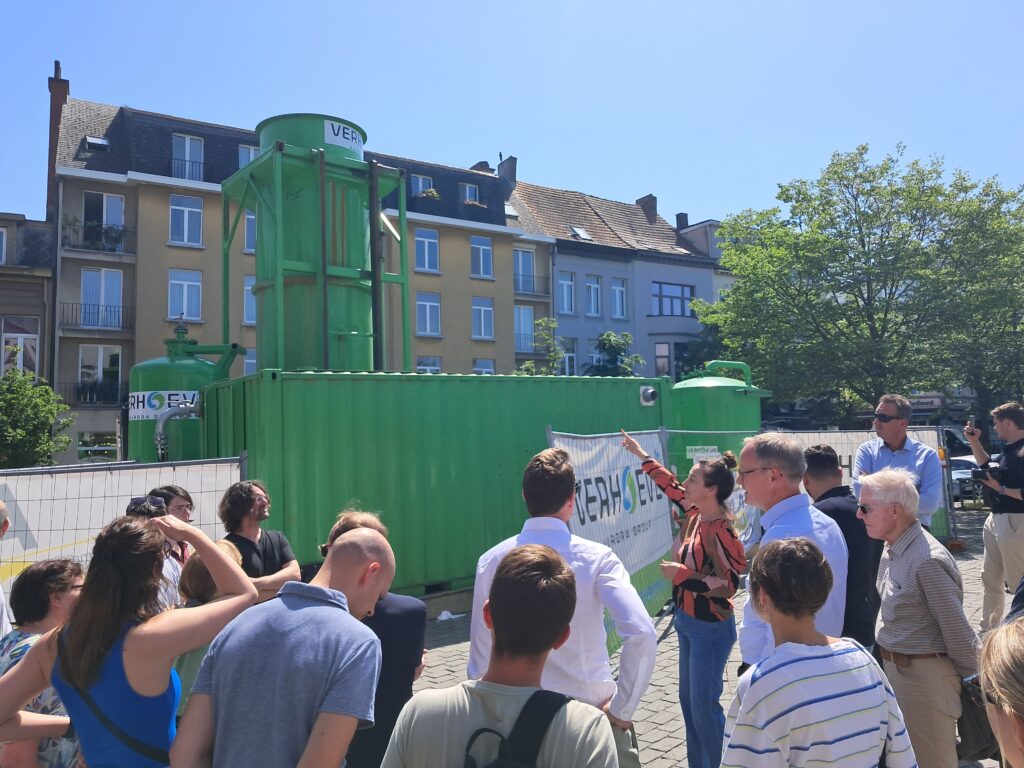
Antwerp – On Thursday, May 28, 2026, Flemish Minister of Environment and Agriculture Jo Brouns visited an active soil remediation facility operated by Verhoeve, commissioned by Vlabotex, on Sint-Jansplein in Antwerp-North. During this visit, Vlabotex and its stakeholders provided the minister with a clear explanation of the challenges of soil remediation in urban environments and of the unique collaboration between the government, the industry, and technical experts that is helping to address historical environmental problems in Flanders and thereby prepare sites for a sustainable future.

A shared challenge and a collaborative approach

In Flanders, historical soil contamination dating back to past activities involving the use of solvents has been identified at various locations. This contamination is often not visible, but it can have an impact on the quality of soil, groundwater, and indoor air in urban environments.

Due to their properties, these substances can spread over greater depths and distances, making soil investigations and remediation technically complex and financially demanding. For individual property owners or businesses—often SMEs—such projects are difficult to undertake on their own.

Against this backdrop, the textile care sector has made an explicit commitment to take responsibility and actively contribute to solutions through the establishment of an industry fund. Thanks to this fund, which is supported by the government, the necessary soil investigations and remediation efforts become financially feasible for the parties involved.

About Vlabotex: Expertise and Solidarity in Action

Vlabotex vzw is the Flemish soil remediation fund for the textile care sector and was recognized by the Flemish Government in 2007. The fund brings together the sector’s resources in a solidarity-based model, combining industry contributions with government support to address historical contamination in a structural, efficient, and coordinated manner. This collective approach makes it possible to tackle issues that are often unfeasible to address individually.

Vlabotex has extensive expertise in solvent contamination and applies that knowledge to conduct targeted and cost-effective soil investigations and remediation projects. As a result, complex projects become not only technically manageable but also financially feasible.

Today, more than 200 sites across Flanders are included in the fund, with the clear goal of completing their remediation in a sustainable and responsible manner by 2036. The remediation consists of groundwater pumping combined with soil vapor extraction. Verhoeve installed dozens of filters under complex conditions (a basement with limited working height), after which the piping was routed underground to Sint-Jansplein.
Want to redevelop contaminated land for real estate without financial risk? Verhoeve Project Participatie makes it possible

Published May 28, 2026

Contaminated soil and redevelopment don’t naturally go hand in hand. The costs are uncertain, the risks are complex, and the timeline is unpredictable. That’s exactly where Verhoeve Project Participatie (VPP), a sister company of Verhoeve Nederland, comes in.

What is Verhoeve Project Participation?

VPP is a specialized partner for owners of contaminated properties looking to pursue redevelopment. That sounds easier than it is. Anyone seeking to transform a contaminated site into residential housing, commercial buildings, or public space quickly faces a host of uncertainties: what exactly is in the soil, how much will remediation cost, and who bears the risk?

VPP combines technical expertise in soil contamination with financial expertise in real estate development. This enables us to conduct a comprehensive assessment of a site and map out a realistic development plan.

What exactly does VPP do?

Depending on the situation and stage of the project, VPP offers support in several areas:

  • Quick assessments of contamination risks to quickly gain insight into the current situation
  • Identifying development opportunities in relation to soil contamination
  • Preparing cost estimates for remediation and redevelopment
  • Risk buyout (partial or full), so that the project initiator is not left with an open-ended commitment
  • Guiding grant applications to make the best use of funding
  • Risk-bearing participation in development projects, in which VPP actively partners with the project

That is what makes VPP unique. It goes beyond mere advice. As a partner, VPP can participate in a development project using its own capital and assuming the associated risk. This builds trust and speeds up decision-making.

Who is VPP relevant for?

VPP works with a wide range of stakeholders dealing with contaminated real estate:

  • Owners of industrial or agricultural real estate facing a remediation challenge
  • Municipalities and government agencies with contaminated inner-city sites
  • Real estate developers who want to acquire a site but want to manage the environmental risk
  • Companies that want to relocate or sell or redevelop their properties

What all these situations have in common is that soil contamination is standing in the way of progress. VPP clears that obstacle.

The power of the combination

VPP is part of the Aurora Group, just like Verhoeve Nederland. This offers a significant advantage: soil remediation, demolition work, and infrastructure projects can be tackled as an integrated whole. Short lines of communication, shared expertise, and a single point of contact for a comprehensive process. For complex sites involving multiple disciplines, this isn’t a luxury—it’s essential for ensuring a smooth turnaround time.

Are you interested in exploring the redevelopment of a contaminated site? Check out the options at www.verhoeveprojects.com.

Intersnack Netherlands and Verhoeve Netherlands are joining forces as part of the "Work Safely" initiative

Published May 29, 2026

Intersnack Netherlands produces nut butters, including peanut butter, and processed nuts for various snacks at its facility in Doetinchem. Since 2022, Verhoeve Netherlands has been treating the wastewater generated by the facility using a complex water treatment plant before discharging it into the municipal sewer system. Verhoeve performs weekly maintenance on the plant. In addition, major maintenance on the entire plant is carried out several times a year.

Safe workplace

Intersnack and Verhoeve place a high priority on a safe workplace. Earlier this year, the Health, Safety, and Environment (HSE) managers from both companies got together to assess whether their respective operations still align with the safety standards set by both companies. The goal was to ensure that safety measures are implemented in a pragmatic way on the shop floor so that they are actually put into practice. The most important result is that employees are aware of each other’s risks and take the necessary actions to bring them down to an acceptable level. Communication and coordination among all parties regarding this during preparation, execution, and completion make all the difference.

Wastewater treatment

Chemicals are used to treat wastewater. The wastewater buffer tank is cleaned in a so-called “confined space.” This work must be performed competently and carefully in accordance with established procedures. However, the overlap with food safety and the HSE aspects of Intersnack’s production process during minor and major maintenance also requires close coordination.

Workplace agreements are set out in a joint health and safety plan. The goal is not to create a mere formality, but rather to provide a clear framework to support us amid the ever-changing dynamics of the workplace. How can we ensure that we work safely together and that every employee returns home safely each evening?

Production Process Safety

The sessions held have led to the development of a joint Health and Safety Plan (H&S) that, for once, does not focus on the safety of each company’s individual staff, but takes a comprehensive approach. What impact does the execution of maintenance work have on safety—both for Intersnack’s production process (including its employees) and for Verhoeve? And how can we ensure that we work safely together and that every employee returns home safely at the end of the day?

It was agreed that the session we held was not a one-time event. In addition to acting in accordance with what we agreed upon and documented, it is also important to monitor, evaluate, and make adjustments as needed, so that we all keep safety and safe working practices firmly in mind.

PFAS laboratory testing: building blocks for a full-scale design

Published May 1, 2026

Over the past few months, Verhoeve has conducted various laboratory tests for PFAS removal for several clients at its testing facility in Dordrecht. These tests include:

  • Column tests using activated carbon;
  • Resin column testing;
  • Foam fractionation testing.

Column tests

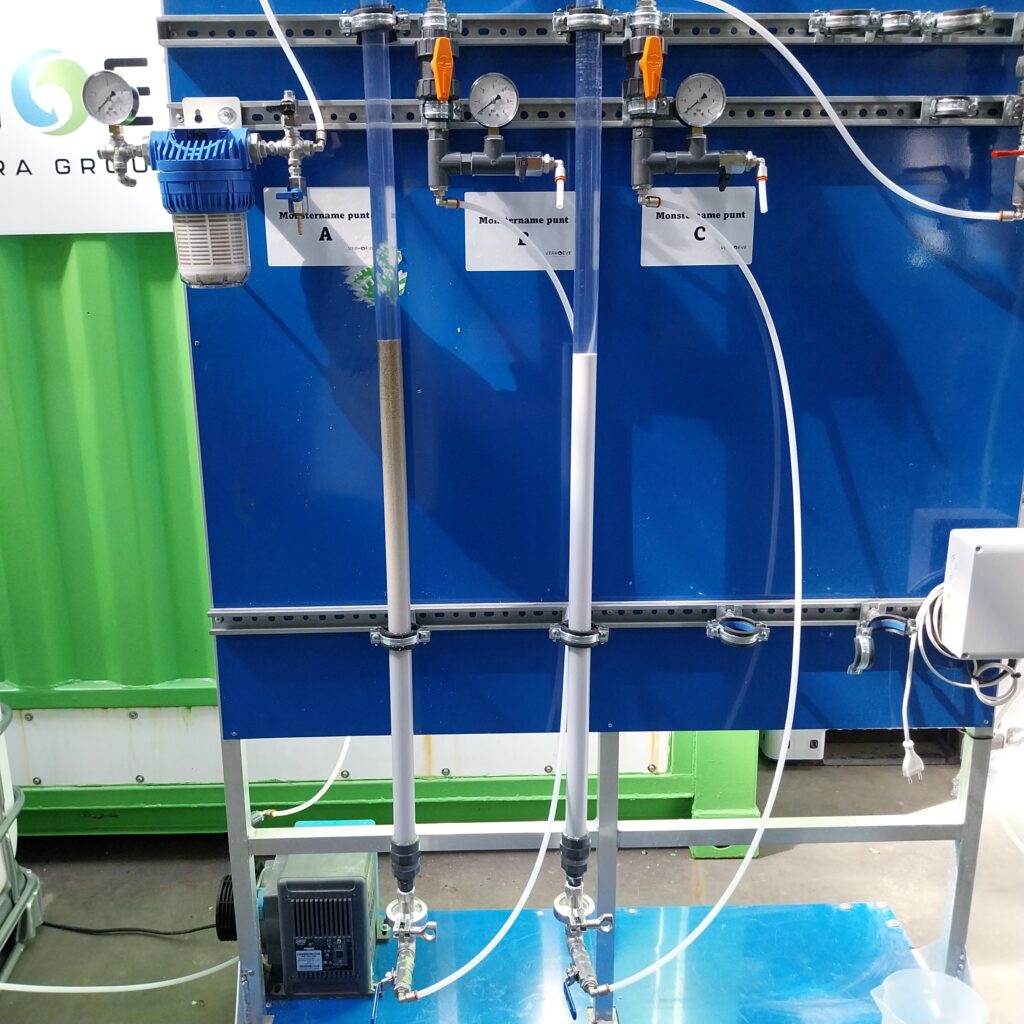
In column tests using activated carbon and resin, the contaminated water is passed over the column containing the adsorption medium at a constant flow rate. In this process, the PFAS are adsorbed onto the medium, with initial recovery rates of up to 100%. The clean water is collected. By regularly analyzing the influent and effluent for PFAS and other parameters, we determine the adsorption efficiency and the breakthrough point. Significant differences in adsorption occur between short-chain and long-chain PFAS. See Figure 1.

Process

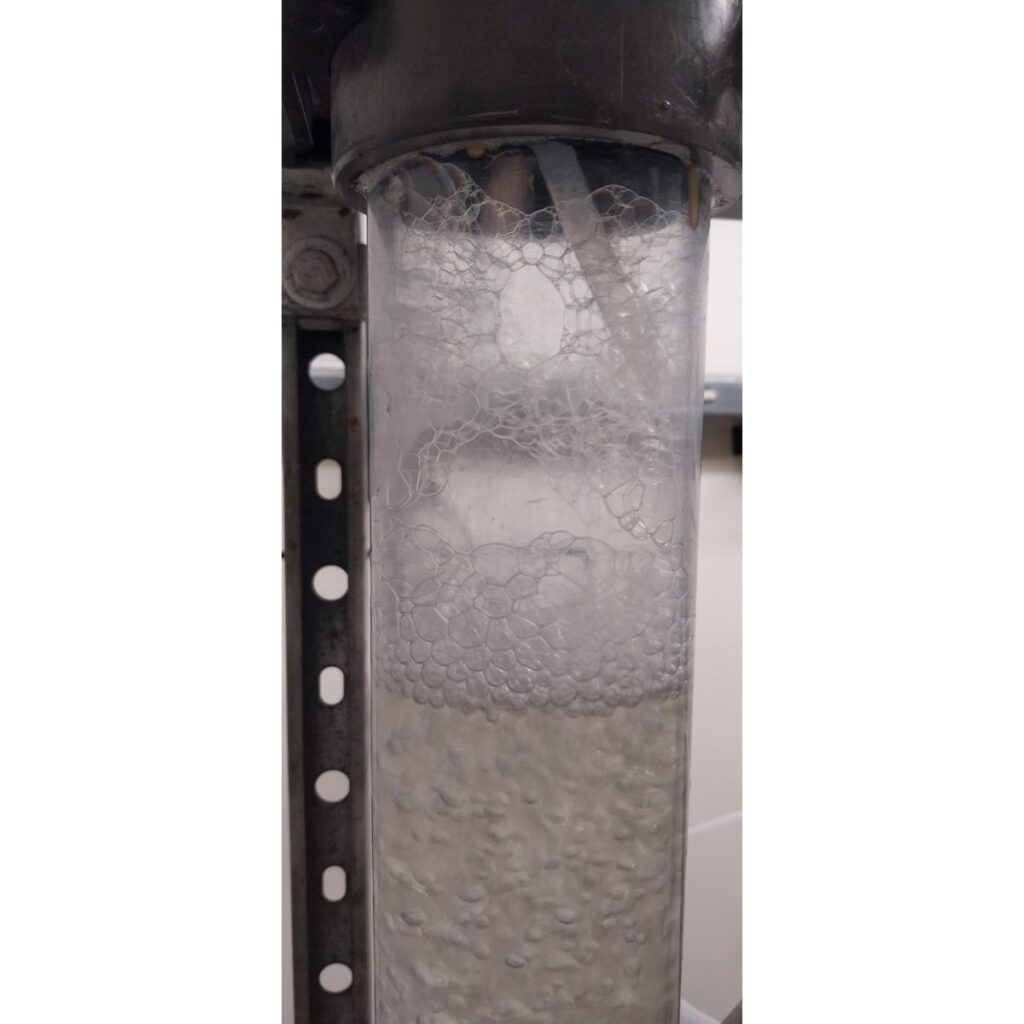
In foam fractionation, we aerate the PFAS-containing water with fine bubbles, causing PFAS foam to form. This foam is separated and collected separately. After the test, two liquid streams remain: one concentrate stream derived from the foam with high concentrations of PFAS, and one permeate stream from which the bulk of the PFAS has been removed. There are also significant differences between individual PFAS compounds. For long-chain PFAS, removal rates of over 95% have been demonstrated. An advantage of the foam fractionation process is that the bulk of the contamination can be concentrated into a small volume for further treatment. The permeate, which contains few PFAS, only slightly burdens any downstream activated sludge and resin, thereby extending their service life. In photo 2, you can see the foam formed during a foam fractionation test.

The column tests using activated carbon/resin and the foam fractionation tests provide valuable insights into the applicability and achievable removal efficiencies for specific PFAS-containing water streams. As such, they serve as important building blocks in the design of PFAS water treatment systems.

Column test setup with resin

Foam formed during foam fractionation