
Verhoeve performs function-oriented soil remediation for construction of Rafelder solar farm in Etten

Published Sept. 29, 2025

Construction of solar parks on former landfills is seen as a sustainable solution. Many times landfills lie aimless and are often used as nothing more than pasture. Remediating the landfill is not economically feasible. Nor, except for a few landfills, do they pose a threat to the environment. The top of the landfill often already has a sufficiently thick cover of soil. Groundwater quality is monitored periodically. More and more solar parks are springing up on former landfills in the Netherlands.
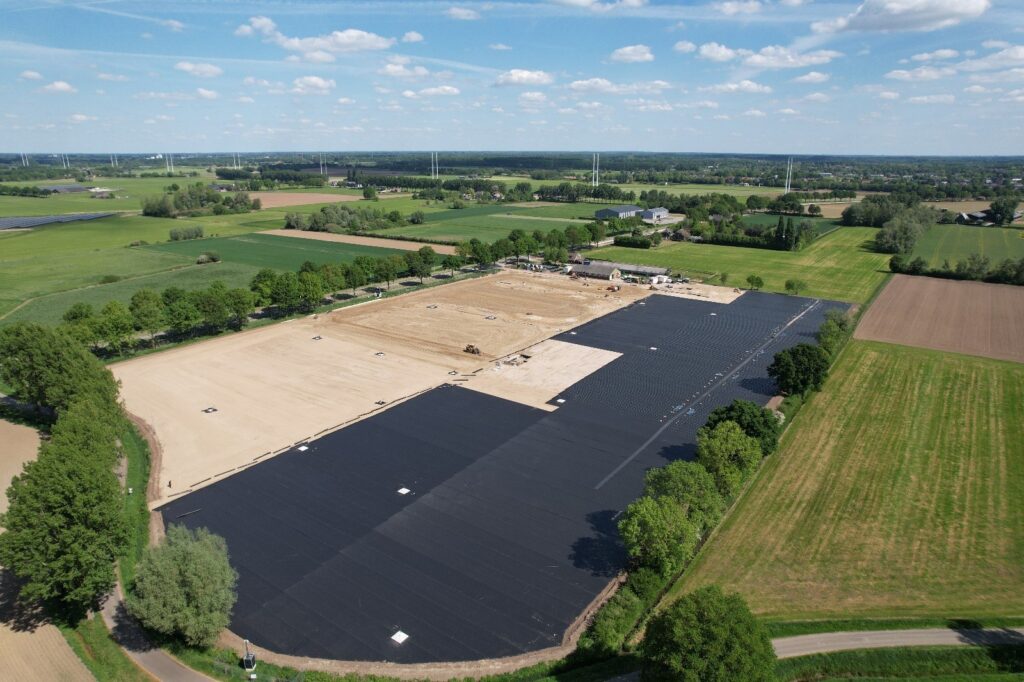
Situation Rafelder (Etten, Achterhoek).

The area has historically been home to brick factories that mined clay in the area as material for bricks and roof tiles. The resulting "clay holes" were then filled with waste from the region. This is also how the former Rafelder landfill site came into existence. 

Soil testing revealed that in addition to landfill material, the soil contains heavy metals and PAH, creating a potential contact risk in the current situation. The covering layer on site was found to be insufficiently thick. Ensuring an adequate covering layer is then the task. What could be better than to combine this with the construction of a solar park. 

Solar farm construction, Verhoeve expertise

Verhoeve was asked by the client to contribute its expertise right from the design phase. This resulted in the execution of a function-oriented soil remediation. 

Client had high requirements for the slope and finish heights of the capping layer. And no grain of landfill material was allowed to be diverted from the site, well re-suspended. 

Verhoeve recorded the baseline situation of the site and entered this data into a 3D model. From the computational model came the optimal earth-moving model, suitable as input for the earth-moving machinery that performed the work.   

After setting aside the existing cover layer, the landfill material was rearranged. After rearrangement, the cable trenches were dug and backfilled with sand. Afterwards, the capping layer was set back and covered with a 20-cm package of sand (signal layer), which was then covered with tissue fabric. 

Verhoeve's expertise has resulted in the realization of a 60,000 m2 solar park that will provide sustainable green energy to the region for decades to come and, not unimportantly, give a former landfill a function again. Completion of the park will take place in October 2025.

Contact

Do you have any questions? Please contact Jan Henk Schuurman(jan-henk.schuurman@verhoevemw.com or +31(0)6 1296 6057).
Applying ozone in Industrial process water? Do's and Dont's!

Published Sept. 29, 2025

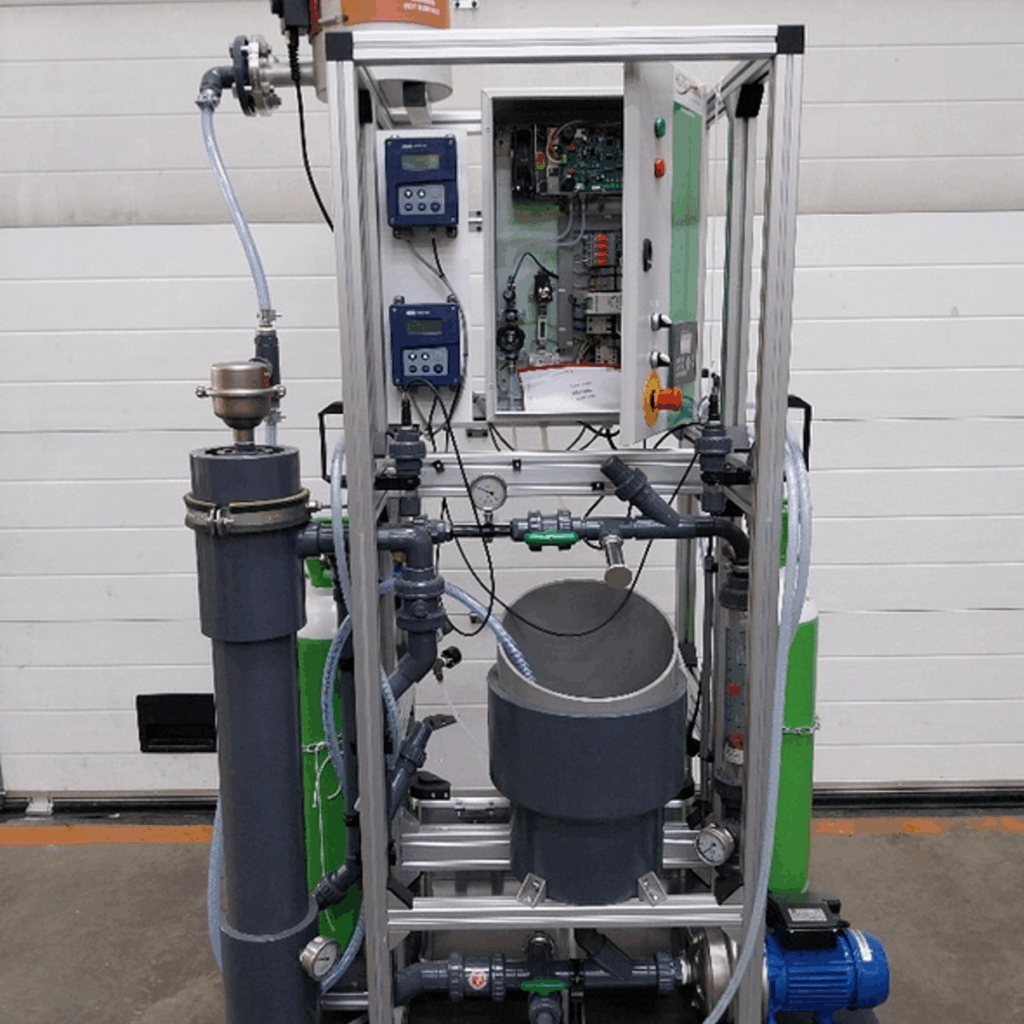
Verhoeve has been working with the active substance ozone (O3) for more than 20 years. A special oxidizing substance (in gas form) that is produced 'on site' via a generator from oxygen and has a good cleaning and disinfecting effect. 

Dealing with contaminants in the soil, dealing with pathogens and bacteria in irrigation or process water, 'cleaning ín place' of airflows: it is all possible, but of course the proper and efficient application requires the necessary know-how and experience. But also to comply with certain rules within the (European) legislation!

It is definitely not the case that every company can 'just' ozone and many applications fall under the so-called Biocide legislation. Verhoeve, together with its sister company Agrozone, is admitted to this via membership of the European association of companies specialized in ozone 'Euota'. 

If ozone is used as a technical solution with the aim of reusing industrial process water (e.g. disinfection of human pathogens and bacteria such as E-coli), approved application is guaranteed on the basis of a certified (self-developed) ozone generator that has demonstrated its ability to fulfill the intended purpose (or better claim). Verhoeve manufactures ozone generators in the range of 7 grams per hour to 2,000 grams per hour. In indiction, this enables water flows of 5 to 200 m3/hour to be treated within the aforementioned goal. Ozone as an active substance has been approved at the European level since 2023.

Another example of an ozone application in industrial process water is decolorization and deodorization and (if possible) the frequently associated high COD content. In this case, incidentally, there is 'oxidation' of certain substances in a water stream and Biocide legislation is also not automatically applicable. 

In industrial process water, application generally takes place in the context of reusing that water: COD removal, decolorization, deodorization and disinfection. It is also used in support of other techniques such as activated carbon (longer retention time) or UV. Used mainly in the food industry, chemicals and textiles.

The advice is to always work with an approved supplier of ozone products (see, for example, www.euota.org for international suppliers). This can quickly establish feasibility in consultation. Further establish design parameters in the laboratory or through a pilot, but always deploy ozone on its strengths: oxidation of specifically difficult to degrade components, decolorization, deodorization. If properly applied and care is taken with proper design, formation of unwanted byproducts such as bromate, for example, can never occur.

Contact

For more information: Art Lobs(06-51107067 or a.lobs@verhoevemw.com) or Edward van de Ven(06-51864919 e.vd.ven@verhoevemw.com), Dordrecht office.

Biological soil remediation of Fenol at Moerdijk

Published Sept. 29, 2025

At an industrial storage site at Moerdijk, Verhoeve removed phenol contamination using an in-situ method during the period 2023-2025. Both implementation and process monitoring were part of the work.

It involved phenol contamination in soil and groundwater from a recent spill. The spill had resulted in phenol being deposited on and in the soil, with locally solidified product present. The contamination was mainly present in the shallow soil layer up to about 3.5 m-mv. In total, 1,250 m3 of soil and 5,000 m3 of groundwater were contaminated. The maximum phenol concentration detected was 10,000,000 µg/l. The presence of company infrastructure prevented removal by excavation and Pump & Treat. To prevent the contamination from spreading further, a management system consisting of Pump & Treat had been put into operation by third parties. The pumped up groundwater containing phenol was temporarily collected in buffer tanks and disposed of by axle at high cost.

Prior to construction, Verhoeve demonstrated by means of a laboratory test in its own test facility in Dordrecht that the contamination could be removed biologically well aerobically. Based on this, Verhoeve drew up a design and Plan of Action. After approval of the Plan by the competent authority, the remediation operation was started.

Biological remediation consisted mainly of administering oxygen, nutrients and bacteria to the soil to facilitate aerobic degradation in the soil. Biosparging filters were installed for oxygenation. A groundwater circulation system (the 3 existing deep wells from the containment and 13 additional infiltration drains) with an above-ground aerobic bioreactor was installed for the administration/dispersal of nutrients and bacteria in the soil.    

During the implementation of the remediation, additional phenol contamination was found in places, where it did not appear to be present during the investigation. At these locations, the system was expanded with additional filters/drains, which were connected to the existing system. For this, the system was designed to be sufficiently flexible and robust.

Beforehand, 2 years of remediation was planned to remove the remediation target. Despite the additional contamination found, we were able to remove the contamination to the agreed remediation target within this time frame (2023 - 2025).

Contact

Do you have any questions? Please contact Jeroen Schoovers(j.schoovers@verhoevemw.com or +31(0)6 2255 2057).