
Soil remediation at Eindhoven site by Verhoeve Nederland

Published January 27, 2026

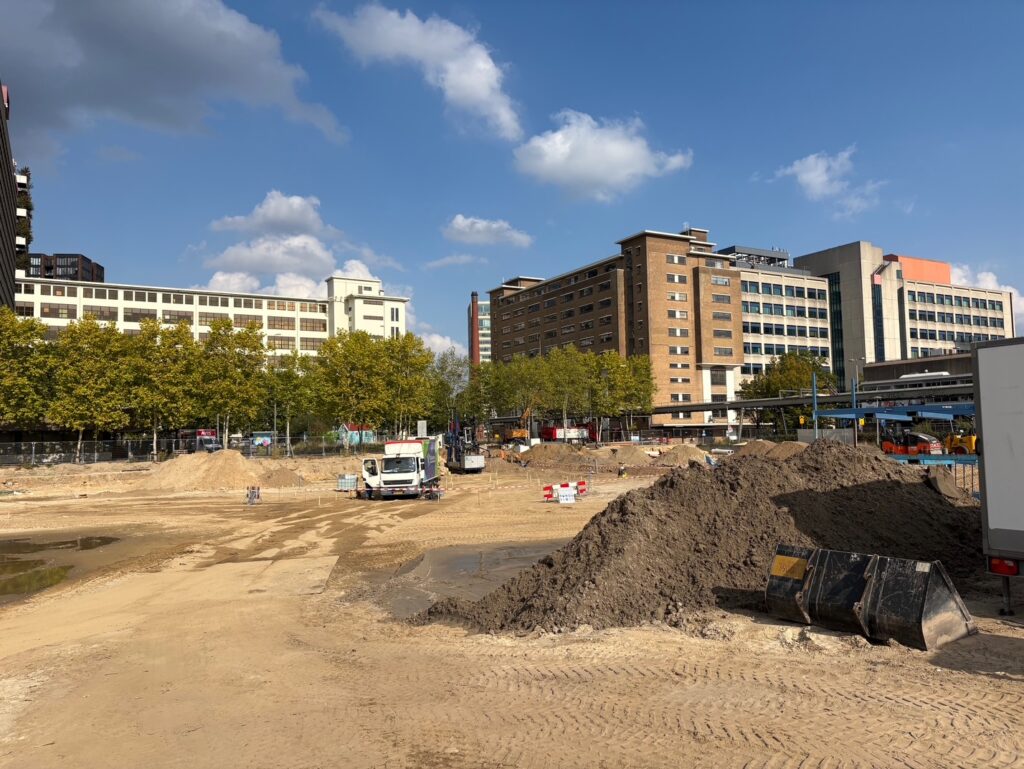
The site is located in an inner-city area in Eindhoven that is undergoing extensive redevelopment. Prior to the new construction, Verhoeve Nederland was asked to carry out soil remediation using direct push injections.

Contamination situation

The area to be remediated covers 4,100 to a maximum depth of 20 m below ground level and is contaminated with VOCL. The total volume of soil to be treated is 33,000.

Remediation measures

The work consisted of performing 418 direct push injections to a maximum depth of 20 m below ground level, with a distance of 5 meters between each injection. A total of 29,000 kg of EHC substrate containing nutrients and bacteria was injected to accelerate the chemical reduction of the VOCL and sulfate present and to stimulate biological degradation. 

These quantities, in particular, posed the greatest challenge for the project given the short timeframe of 12 weeks for implementation. Verhoeve therefore deployed multiple teams and multiple injection techniques simultaneously. 

During the execution, highly compacted sand layers proved to cause a lot of friction, which presented a number of technical challenges. Drill bits had to be replaced regularly because they were damaged, as shown in the photo below. 

Planning

Due to the urgent nature of the project, work commenced immediately after the contract was awarded in the last week of September 2025. The site was cleared immediately before the 2025/2026 Christmas break. The project was completed in 10 weeks thanks to the deployment of multiple teams and machines. 

In parallel with the injections, careful coordination of the work phases enabled the construction contractor to start work on the K&L infrastructure.
Verhoeve performs groundwater remediation at former Gijzenrooi landfill site Eindhoven

Published June 20, 2025

In the southeast of Eindhoven in the hamlet of Gijzenrooi is a former landfill site. Waste was dumped at this site in the past by nearby industries. The dump material consists of house waste, demolition waste, waste oil and chemical waste, including paint residues and solvents. As a result, the groundwater in the plume has become contaminated over the years. Several years ago, the landfill material was rearranged to a limited extent within the landfill and the landfill was provided with a sufficiently thick cover layer of clean soil. The site is located in a difficult-to-access natural area which makes equipment accessibility challenging.

Addressing VOCL contamination.

Groundwater quality has been monitored annually since 2011. Recent groundwater monitoring showed that achieving the agreed stable final situation is not feasible with groundwater monitoring alone. It proved necessary to fall back on a fallback scenario. The fallback scenario consists of two components:

1. Address the source of solvents in the landfill so that solvents are no longer dispersed from the landfill. 

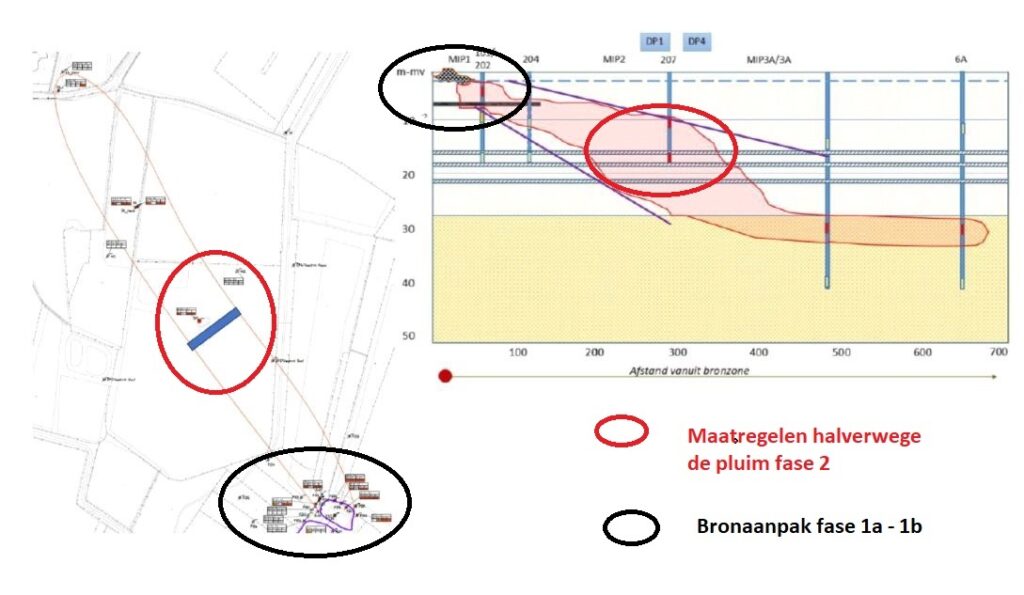
2. Halfway up the plume to optimize solvent degradation conditions and stimulate degradation.

Implement source approach (1a)

Work began early this year to remove the portion of the landfill from which the contamination in the groundwater plume originated. The purpose of this measure is to prevent secondary delivery of contamination from the landfill to groundwater.

Stimulate anaerobic degradation near the landfill (tap closed) (1b)

The purpose of stimulating anaerobic biodegradation is to prevent groundwater contamination from causing long-term recharge to the plume zone. In the area near the landfill with the highest concentrations, anaerobic biodegradation is stimulated.

The approach adopted was grid-wise direct injections to 10 m -mv for the purpose of anaerobic degradation/chemical reduction to terminate subsequent delivery of contamination to the plume. Distributed over an area of approximately 650 m2, zero-valent ferrous organic substrate was injected with bacterial graft.

Supplemented by verification of the process of occurrence of optimal degradation conditions for chlorinated hydrocarbons and decreasing concentrations. Carried out by periodic sampling of groundwater monitoring well filters in the treated area.

Measures midway through the plume (2)

A remediation measure is currently being devised by Verhoeve Nederland together with Royal Haskoning DHV and the client, the Municipality of Eindhoven, and will soon be implemented. The goal is to achieve effective cargo removal in the plume zone in order to realize a stable contamination plume with more certainty in the long term. In line with the source approach, direct injection has also been chosen here, but now in the 20-30 m-mv zone. Simultaneously with the monitoring of the source, the plume will also be monitored in the coming years.

Leveraging market expertise

Give Verhoeve a soil problem or research question and we will look for a solution. In this project, too, we worked with the client to find the best technique with the best value for money. We are good at that, so challenge us!

Contact

Do you have any questions? Please contact Jan Henk Schuurman(jan-henk.schuurman@verhoevemw.com or +31(0)6 1296 6057).