
Removal of chloride
via Electroreclamation in Nantong.
China is experiencing large-scale environmental problems as a result of its massive economic growth spurt. Mainly, China's industrial growth in recent years has come at a price. The soil and groundwater in China are highly contaminated locally with a wide range of toxins (including heavy metals), making it unusable as agricultural land or for use as drinking water, for example.
Electro-Reclamation (ER) is a remediation technique that uses direct current to remove inorganic contaminants from soil and/or groundwater. For example, the technique can be used to remove heavy metals and cyanide. The principle of the ER technique is based on potential differences, causing positively charged particles to migrate to the cathode and negatively charged particles to the anode. A special electrolyte circulation system is used to remove the contaminated particles around the electrodes. Treatment of the contaminated electrolyte takes place in an electrolyte purification system.
Verhoeve Environment & Water conducted a laboratory test on behalf of Elion Environmental Protection Co., LTD China for a site near the city of Nangtong. The site was mainly contaminated with chloride. This contamination was caused by the discharge of wastewater containing hydrochloric acid which was applied for the surface treatment of metals.
The ER test was conducted with soil and groundwater samples from the contaminated site. The samples were taken from the three former production ponds. The main purpose of the test was to collect the necessary data to realize a full-scale remediation design. The turbo test results were very promising. An overall removal efficiency of 97.1% for chloride was achieved in the soil.
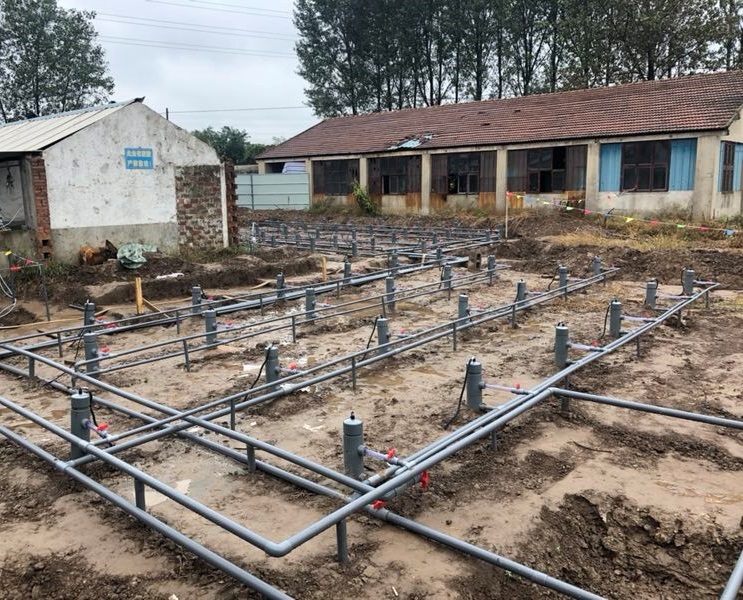
At Elion's request, a full-scale approach was developed based on the results of the lab tests. In cooperation with Elion, the Electro Remediation unit was installed by Verhoeve Environment & Water on site (Nangtong) in October 2018 at the site of three production ponds. The ponds will be remediated during 2018 and early 2019.