Published Sept. 24, 2024
Former Channel Polder landfill remediated: A piece of nostalgia and a moment of reflection
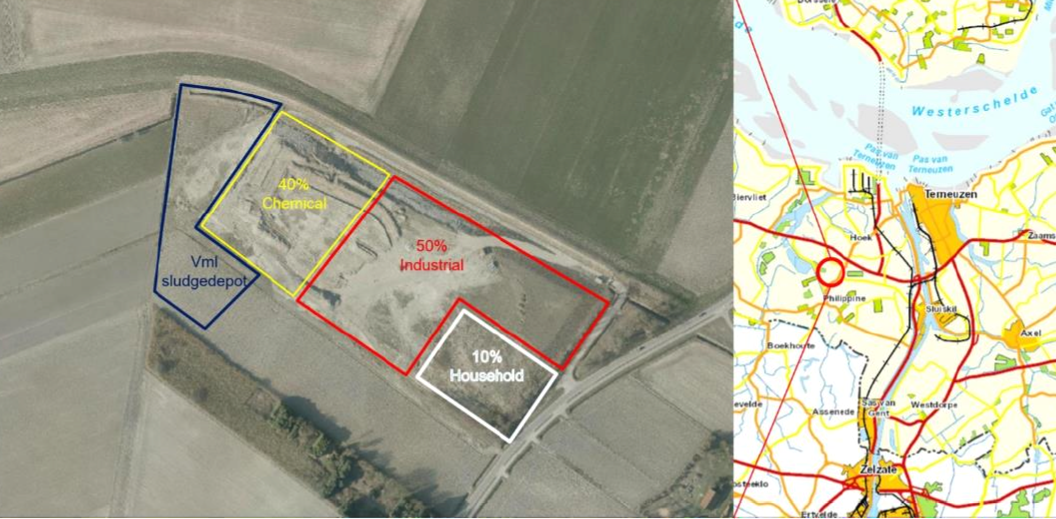
In 2012, the contract was signed between the province of Zeeland and Verhoeve for the largest soil remediation project in the province: the soil remediation of the Kanaalpolder household and chemical landfill in Philippine.
A former landfill where soil and groundwater became contaminated with a cocktail of contaminants: oil, aromatics, vocl, phenols, creosols, etc.
Total contaminated soil volume: 505,000m3, available budget: €1,800,000, and available time: through 2024. Go figure. A cocktail of contaminants requires the use of a cocktail of techniques that Verhoeve has at its disposal. Chemical, physical and, of course, biological.
Remediation Objective:
The remediation will effectively remove as much contamination load as possible within the target area in order to achieve a clear and sustainable improvement in groundwater quality in the source and plume areas. By reducing the load in the source area and parts of the plume area, subsequent delivery of the (residual) contamination to the groundwater is minimized. The concentrations in the groundwater then decrease over time due to degradation and dilution, the plume will have to become stable within a period of 30 years. The vulnerable objects (surface water in ditches and Philippine Canal) will no longer be threatened. This will create an environmentally acceptable final situation within 30 years without the need for active aftercare. After completion, normal use of the area will be possible with limited restrictions on use.
After lab testing and pilot testing, Verhoeve began Full-scale remediation in 2017 using:
- Chemical oxidation (ISCO);
- Biosparging;
- Pump and Treat.
Initially, the extremely high hotspots were addressed by ISCO (Perozox®). As soon as a sub-area was no longer toxic, a switch was made to biosparging and finally the contaminated water was extracted in the toe of the landfill (downstream) by means of deep wells to be infiltrated again on the landfill and there to infiltrate through the biologically active zone.
Now it's 2024 and where are we now?
The remediation evaluation report is currently before the Competent Authority for approval. The result achieved has been tested against the components of the remediation objective above:
- As much freight removal as possible: there has been a significant freight reduction from 90% to 96%;
- Within the target area, no pure product is left in the saturated zone;
- There is an environmentally acceptable final situation with shrinking plume (at the end of active remediation in 2022 already 80% soil volume reduction);
- The vulnerable objects surface water in ditches and Philippine Canal are not threatened.
Conclusion
The result achieved meets the objective of groundwater remediation. The groundwater remediation can be completed. Something we can all be proud of. Zeeland is cleaner again.