
Verhoeve performs function-oriented soil remediation for construction of Rafelder solar farm in Etten
Published Sept. 29, 2025
Construction of solar parks on former landfills is seen as a sustainable solution. Many times landfills lie aimless and are often used as nothing more than pasture. Remediating the landfill is not economically feasible. Nor, except for a few landfills, do they pose a threat to the environment. The top of the landfill often already has a sufficiently thick cover of soil. Groundwater quality is monitored periodically. More and more solar parks are springing up on former landfills in the Netherlands.
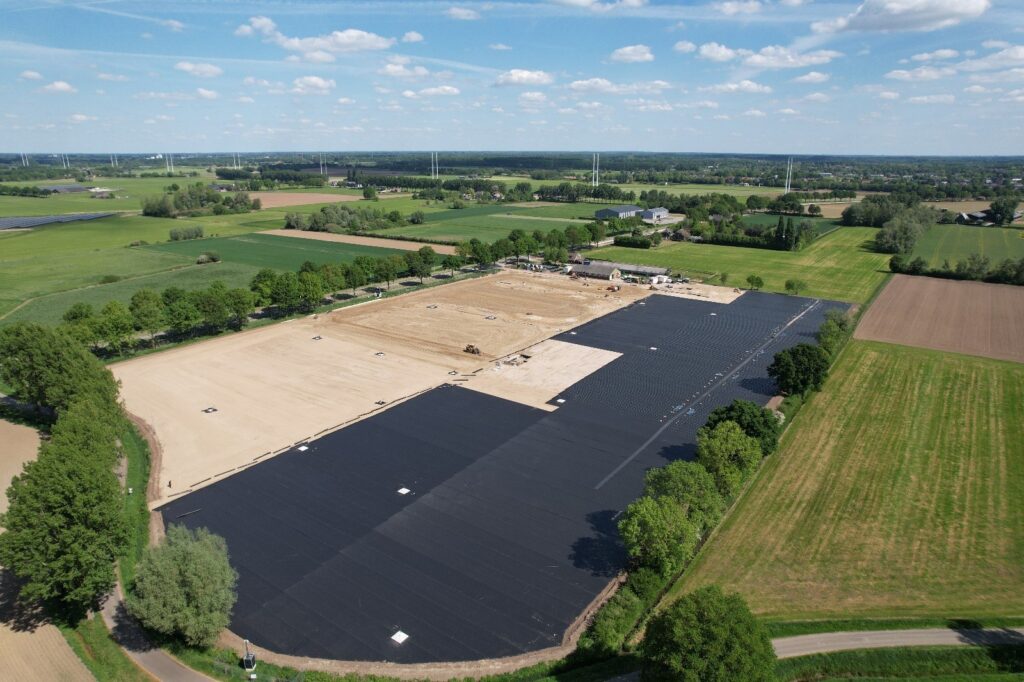
Situation Rafelder (Etten, Achterhoek).
The area has historically been home to brick factories that mined clay in the area as material for bricks and roof tiles. The resulting "clay holes" were then filled with waste from the region. This is also how the former Rafelder landfill site came into existence.
Soil testing revealed that in addition to landfill material, the soil contains heavy metals and PAH, creating a potential contact risk in the current situation. The covering layer on site was found to be insufficiently thick. Ensuring an adequate covering layer is then the task. What could be better than to combine this with the construction of a solar park.
Solar farm construction, Verhoeve expertise
Verhoeve was asked by the client to contribute its expertise right from the design phase. This resulted in the execution of a function-oriented soil remediation.
Client had high requirements for the slope and finish heights of the capping layer. And no grain of landfill material was allowed to be diverted from the site, well re-suspended.
Verhoeve recorded the baseline situation of the site and entered this data into a 3D model. From the computational model came the optimal earth-moving model, suitable as input for the earth-moving machinery that performed the work.
After setting aside the existing cover layer, the landfill material was rearranged. After rearrangement, the cable trenches were dug and backfilled with sand. Afterwards, the capping layer was set back and covered with a 20-cm package of sand (signal layer), which was then covered with tissue fabric.
Verhoeve's expertise has resulted in the realization of a 60,000 m2 solar park that will provide sustainable green energy to the region for decades to come and, not unimportantly, give a former landfill a function again. Completion of the park will take place in October 2025.
Contact
Do you have any questions? Please contact Jan Henk Schuurman(jan-henk.schuurman@verhoevemw.com or +31(0)6 1296 6057).